Welcoming the DanceSport Community
Kalamata provides the setting in which competitors, coaches, adjudicators and visitors meet, compete and experience Greek hospitality.
Celebrating a relationship built through cooperation, hospitality and a shared commitment to welcoming the DanceSport community to Kalamata.
Behind every successful event, there are partnerships that make the experience possible. For the Kalamata Dance Cup, the relationship with the Municipality of Kalamata has been an important part of the event's journey.
Through successive editions of KDC, Kalamata has welcomed dancers, coaches, adjudicators, families and visitors from Greece and abroad, offering the setting in which sport, performance, culture and hospitality come together.
We therefore wish to express our sincere appreciation to the Municipality, its services and all those who contribute to making this cooperation possible.
Kalamata is part of the identity of the Kalamata Dance Cup. Its people, its hospitality, and its relationship with culture and sport have become part of the experience that athletes and visitors take home with them.
With sincere appreciation for its continued cooperation and support of the Kalamata Dance Cup.

The Kalamata Dance Cup extends its sincere appreciation to the Mayor of Kalamata, Athanasios P. Vasilopoulos, in recognition of the Municipality's cooperation and institutional support throughout the development of KDC events.
Previous editions of the Kalamata Dance Cup have been supported by the Municipality, including cooperation concerning the municipal sporting venue and the organizational framework required to welcome competitors and visitors to the city.
This continuing relationship allows Kalamata to serve not simply as the location of the competition, but as an integral part of the event's identity and its connection with the wider DanceSport community.
The relationship between Kalamata and KDC reaches beyond the competition floor and into the wider experience of athletes, families, visitors and the local community.
Kalamata provides the setting in which competitors, coaches, adjudicators and visitors meet, compete and experience Greek hospitality.
KDC connects competitive DanceSport and performing arts with a city that has a strong relationship with cultural expression.
The event creates a meeting point for athletes, families, local professionals and audiences through a shared celebration of dance.
Repeated cooperation provides continuity and allows KDC to continue developing its international DanceSport and performing-arts programme.
From the earlier editions of the Kalamata Dance Cup to the 8th KDC 2026, cooperation with local institutions has helped provide the environment in which the event can continue to welcome the DanceSport community.
The competition established its identity in Kalamata, connecting the event permanently with the city and its community.
As KDC developed, institutional cooperation helped support the venue and broader organizational requirements of successive editions.
The 8th Kalamata Dance Cup continues the journey, bringing DanceSport and performing arts back to Kalamata for another international gathering.
For competitors and visitors, KDC begins on the dance floor but extends far beyond it.
The city becomes part of every journey — the Mediterranean atmosphere, the local hospitality, the meetings between dancers and the moments shared before and after the competition.
That is why Kalamata is more than the destination printed on an event programme.
It is the home of the Kalamata Dance Cup.
To the Municipality of Kalamata, to Mayor Athanasios P. Vasilopoulos, to the municipal services and to the people who help make every edition possible: our sincere appreciation.
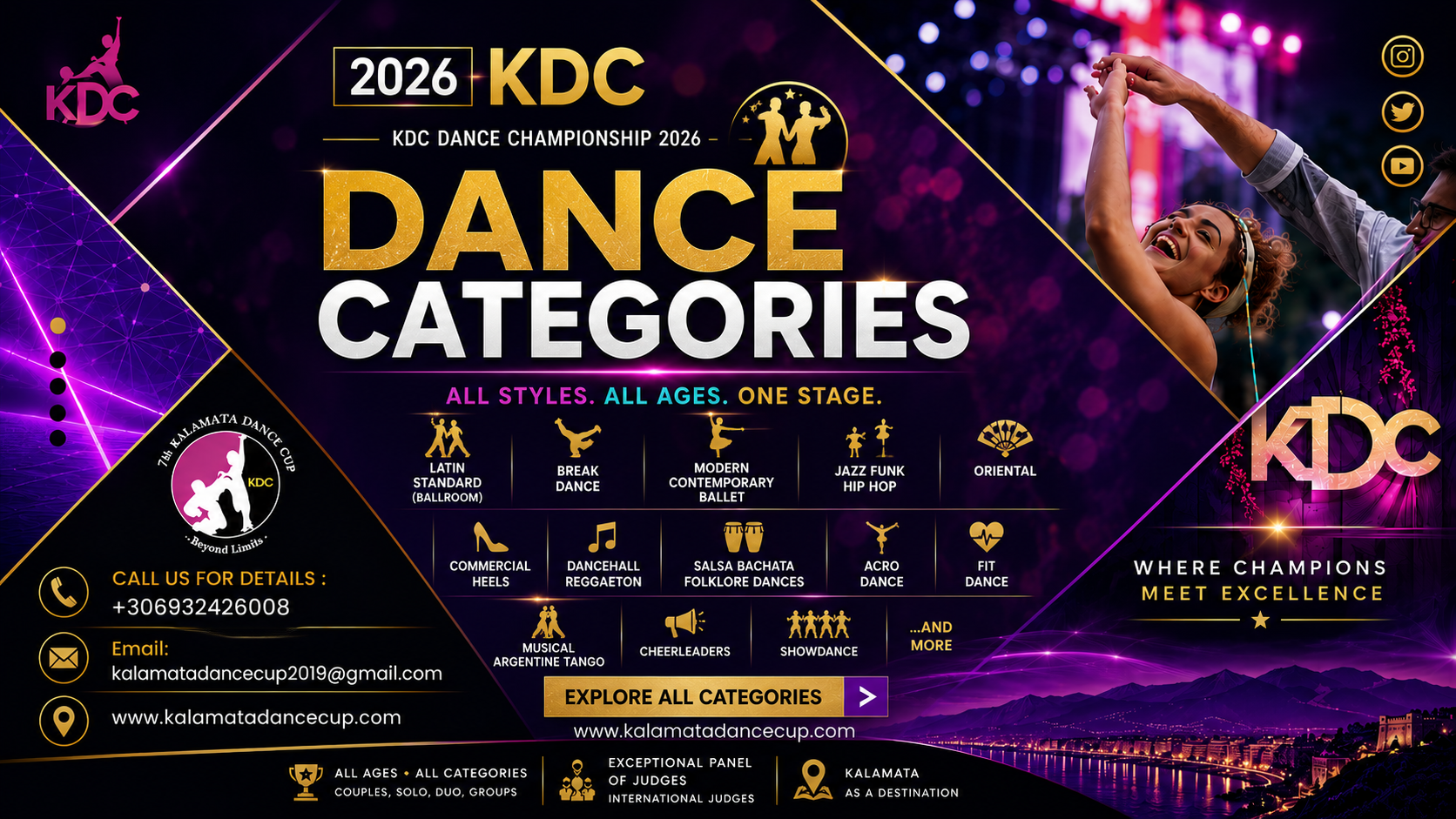
The official KDC dance disciplines have been carefully defined, structurally reviewed and organized into a clear and standardized competition schedule.
Across all disciplines, dancers may participate in the following formation types.
Amateur, Professional, Pro-Am (Teacher & Student), and Rising Stars.
Solo, Duet / Duo, and Trio.
Small Groups, Large Teams, Formations, and Rueda.
Five major dance umbrellas organize the official KDC competition disciplines.
Cha Cha Cha · Samba · Rumba · Paso Doble · Jive
Slow Waltz · Tango · Viennese Waltz · Slow Foxtrot · Quickstep
Solo · Duo · Couples · Formations (All Ladies / Latin Show) · Teacher & Student (Pro-Am)
Classical Ballet · Ballet Pointes · Classical Repertoire
Contemporary · Modern / Jazz ·
Acro Dance / Acro Modern · Show Dance (All Styles) ·
Musical Dance (Championship Only) · Flamenco
Hip Hop · Commercial · K-Pop · Dancehall · Reggaeton
Breakdance (Breaking) · High Heels (18+ / Adult 19+)
Salsa (On1 / On2) · Bachata (Sensual / Dominican) · Salsa Ladies Style · Bachata Ladies Style
Formation Bachata · Rueda de Casino · Argentine Tango (Escenario / Salón)
Zeimbekiko · Hasapiko · Regional Folk Dances
Oriental / Bellydance · Bollywood · Tribal Fusion
A clear overview of the principal focus areas for Saturday and Sunday.
International Latin, Ballroom Standard, Pro-Am, Argentine Tango and Caribbean Mix.
Contemporary, Modern, Ballet, Showdance, Hip Hop, Commercial, Breaking, High Heels, Oriental and Greek Folk Dances.
Clear and standardized age divisions designed to make KDC competition categories easy to understand and navigate.
Official age divisions for KDC competition entries.
Youngest participant category for dancers aged 4 to 6 years.
Dancers aged 7 to 9 years.
Dancers aged 10 to 11 years.
Dancers aged 12 to 13 years.
Dancers aged 14 to 15 years.
Dancers aged 16 to 18 years.
Special eligibility category for dancers aged 19 to 20 years.
General adult category for dancers aged 19 years and above.
Special age category for dancers aged 35 years and above.
Under 21 is presented as a special eligibility category because dancers aged 19–20 may also fall within the general Adults classification.
The Kalamata Dance Cup is committed to providing athletes, coaches and dance schools with a transparent competition environment. This guide explains how KDC approaches competitive levels, syllabus restrictions and Formation DanceSport in accordance with internationally recognized DanceSport principles.
KDC does not treat competition as simply a performance on the floor. Every athlete enters a defined competitive environment where level, technical vocabulary, choreography, musical interpretation, partnering, presentation and overall performance are evaluated according to the requirements of the selected discipline.
Athletes should enter the category that accurately represents their technical development and competitive experience. The distinction between syllabus, Pre-Championship and Championship competition is fundamental to maintaining a fair competitive environment.
Advanced choreography does not replace technical quality. Posture, alignment, balance, timing, footwork, body action, partnering, musicality and controlled execution remain fundamental elements of DanceSport performance.
KDC recognizes the complete DanceSport performance: technical execution, musical interpretation, movement quality, partnership, character, floorcraft, presentation and the ability to communicate the identity of the selected dance.
These divisions represent the advanced competitive environment of KDC DanceSport. The emphasis moves beyond basic syllabus execution toward complete technical, musical and artistic performance.
A competitive bridge between restricted syllabus competition and full Championship-level DanceSport.
The highest competitive environment, where athletes demonstrate complete technical and artistic command of the discipline.
At advanced levels, judges evaluate the total competitive product rather than a single technical feature.
At Pre-Championship and Championship level, athletes are expected to demonstrate a level of technical maturity appropriate to the category. Difficulty alone is not the objective. The quality, control, timing, musicality and clarity with which movement is executed are essential components of a successful performance.
The KDC syllabus structure is designed to provide a progressive technical pathway for developing athletes while creating a clear framework for teachers, coaches and adjudicators.
Foundation-level competitive vocabulary designed to establish correct technical habits and musical awareness.
Developing competitive athletes demonstrate greater technical control, variety and confidence within the recognized syllabus.
Advanced syllabus competitors demonstrate a high degree of technical consistency and performance quality while remaining within the defined syllabus framework.
A closed syllabus creates a common technical language between athletes and enables competition to focus on execution rather than access to unrestricted choreography.
The purpose of a closed syllabus is not to limit creativity permanently. It establishes a progressive educational pathway. Athletes first learn to execute recognized movement with precision before progressing toward the greater choreographic freedom and technical demands of Pre-Championship and Championship competition.
Formation competition expands DanceSport from individual partnership performance into coordinated team performance. Technical quality, synchronization, formations, transitions and collective musical interpretation become essential.
Latin Formation emphasizes rhythmic clarity, dynamic body movement, characteristic Latin action and the ability of the entire team to perform as one coordinated unit.
Standard Formation emphasizes posture, frame, movement continuity, musical interpretation and the visual unity of the team while maintaining the character of the Standard dances.
Formation competition is not simply a group of couples dancing at the same time. Judges must be able to identify collective precision, synchronization, spacing, formation geometry, transitions, musical unity and the preservation of authentic DanceSport characteristics. Individual technical quality remains important, but the team must ultimately perform as a single artistic and technical unit.
The best competition experience begins before you step onto the floor. Athletes and teachers should evaluate technical ability, competitive experience and syllabus knowledge before selecting a category.
KDC structures its DanceSport competitions around internationally recognized DanceSport principles, competition practices and technical standards. Specific competition regulations, permitted figures, syllabus restrictions, costumes, music, formation requirements and judging procedures are governed by the official regulations published for each KDC event and category. Athletes and coaches should always consult the current KDC Competition Rules and official event regulations applicable to their entry.
KDC 2026 Competition Selector →
Foundation Syllabus Competition Level
The Beginner level is the entry point of the KDC Syllabus pathway. It provides dancers with a structured environment in which to develop fundamental technique, musicality and competitive confidence.
D and E syllabus classifications.
Introduction to structured DanceSport competition through a defined syllabus pathway.
Specific events and dances are determined by the applicable KDC competition programme.
Developing Syllabus Competition Level
The Intermediate level represents the next stage of the KDC Syllabus pathway. It is designed for dancers who have progressed beyond the Beginner level and are developing greater technical and performance ability.
B and C syllabus classifications.
Builds technical consistency, musical interpretation and competitive performance.
Specific events and dances are determined by the applicable KDC competition programme.
Advanced Development Competition Level
Rising Star provides a competitive pathway for dancers progressing beyond the structured syllabus levels and developing toward higher-level DanceSport competition.
Technical development, performance quality and competitive progression.
Available within the age categories and events specified by KDC regulations.
Provides a bridge toward Championship-level competitive DanceSport.
Premier Competitive Level
Championship represents the highest principal level of KDC DanceSport competition, bringing together dancers competing at an advanced performance and technical standard.
High-level technical execution, musicality, presentation and competitive performance.
Championship events are organised according to the applicable KDC age classifications.
Specific Championship events are defined within the KDC competition programme.
Specialised KDC Competition Formats
Special Levels accommodate competition formats or classifications that require rules and structures distinct from the principal competition levels.
Specific KDC events may operate under dedicated competition conditions.
Alternative participation or performance formats may be incorporated where applicable.
Each Special Level follows the rules and eligibility requirements published for the relevant event.
Page 1 of 2